
WooCommerce and Shopify solve the same problem in fundamentally different ways, and the “which is better” question depends entirely on what kind of store you’re running. Looking at the wider web, WooCommerce is still the most widely used ecommerce platform overall, powering around 39% of sites that run a named ecommerce platform, compared to roughly 28% for Shopify. But flip to the top 1 million highest-traffic sites, and Shopify pulls ahead — a sign that each platform tends to win a different kind of merchant. Here’s how to think about which one fits your store.
The Core Difference: Owned Platform vs. Managed Platform
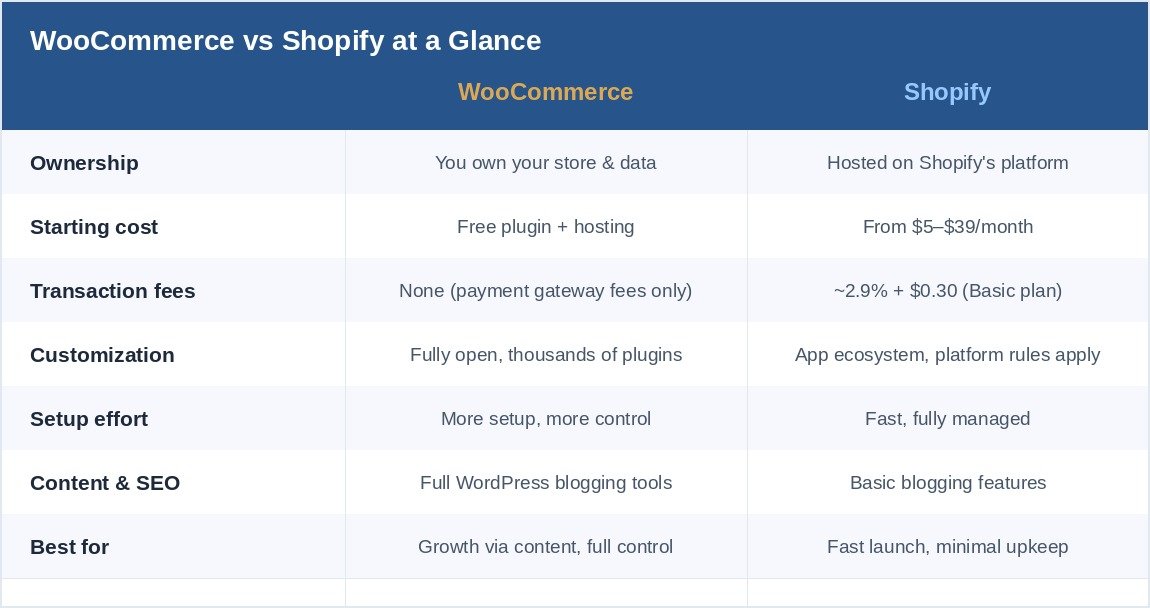
WooCommerce is a free plugin that turns a self-hosted WordPress site into a store you fully own and control — your data, your hosting, your customizations, with no platform permission required to change anything. Shopify is a fully hosted, managed platform: it handles servers, security, and uptime for you, in exchange for a monthly subscription and a more locked-down environment.
Pricing: Lower Ceiling on WooCommerce, Predictable Floor on Shopify
WooCommerce itself is free, but you pay for hosting, a domain, and any premium extensions you choose — costs that can be very low for a small store or scale up for a large one. Shopify’s pricing is a fixed monthly subscription, currently starting around $5/month for a basic starter tier and $39/month for the standard “Basic” plan, plus per-transaction card fees on top (roughly 2.9% + $0.30 on the Basic plan, dropping slightly on higher tiers). Shopify’s cost is predictable and bundled; WooCommerce’s cost is usually lower at small scale but requires more decisions along the way.
Customization and Control
This is where WooCommerce clearly wins. Because it runs on WordPress, you have full access to the code, thousands of plugins for virtually any feature, and no restrictions on design or functionality. Shopify’s app ecosystem is large and polished, but you’re building within Shopify’s platform rules, and some deep customizations require its more expensive Plus tier or are simply not possible.
Ease of Setup and Maintenance
Shopify wins here for a non-technical owner: sign up, pick a theme, add products, and you’re live, with hosting and security handled entirely behind the scenes. WooCommerce requires more setup — choosing hosting, installing WordPress, configuring the plugin — and ongoing maintenance like updates and backups, though a managed WordPress host or a maintenance plan removes most of that burden.
Content, SEO, and Blogging
Because WooCommerce is WordPress at its core, it has the strongest content and blogging tools of the two by a wide margin — genuinely useful if your growth strategy leans on SEO and content marketing alongside the store itself. Shopify’s blogging features are functional but noticeably more limited, since content was never the platform’s primary focus.
Which One Should You Choose?
Choose Shopify if you want a fully managed platform, minimal technical overhead, and predictable monthly costs, and you’re comfortable working within its ecosystem and fee structure. Choose WooCommerce if you want full ownership of your store and data, deep customization, lower costs at smaller scale, and a platform that also doubles as a serious content and SEO engine.
How Danovate Solutions Can Help
If WooCommerce is the right fit, our WooCommerce Development service covers everything from a new store build to migrating an existing Shopify or WooCommerce site without losing SEO rankings or order history. Get in touch and we’ll help you figure out which platform actually fits your business, not just which one is trending.