Remote work stopped being a workaround years ago — it’s now how most software gets built, including WordPress websites. But “remote” also made it easier for under-qualified freelancers and overseas mills to look identical to genuinely skilled agencies on a website or a Fiverr profile. WordPress alone powers roughly 33% of all websites and about 64% of the entire CMS market, which means there is an enormous, noisy pool of people claiming to be “WordPress experts.” Here’s how to actually tell the difference before you sign a contract.
Why Businesses Are Going Remote for WordPress Development
Hiring remotely isn’t just about saving money, though it usually does. A remote-first agency can pull specialists — a security-focused developer, a performance engineer, a WooCommerce specialist — into your project instead of handing everything to one generalist in a local office. For businesses in the US, UK, or anywhere else, it also means access to teams working across time zones, so work can genuinely continue overnight instead of stalling until 9am local time.
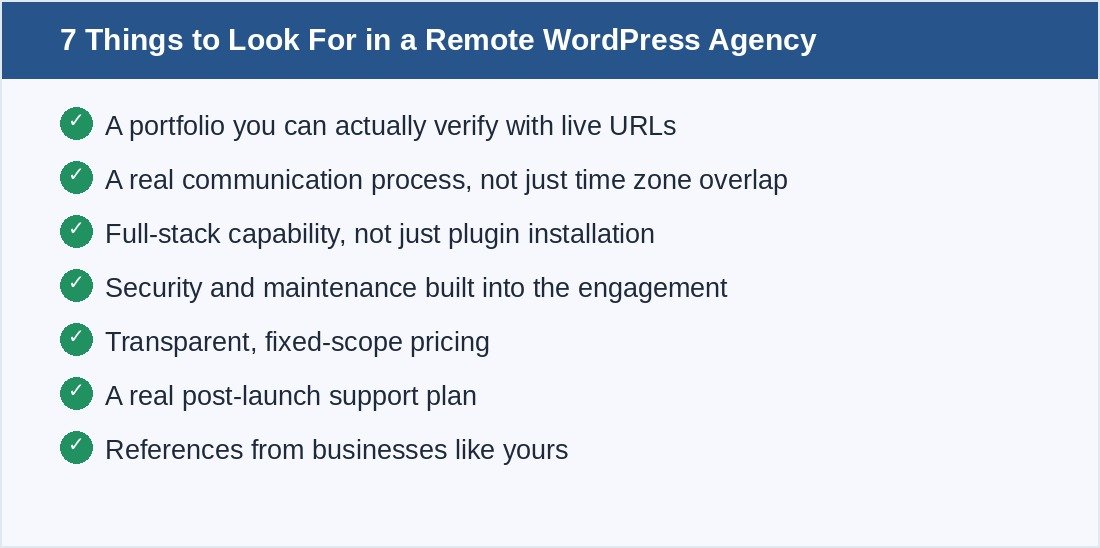
7 Things to Look For in a Remote WordPress Agency
1. A Portfolio You Can Actually Verify
Screenshots in a PDF mean nothing. Ask for live URLs you can visit, click around, and test on your phone. Bonus points if they’ll tell you which specific problem they solved on that project — a redesign, a migration, a security cleanup, a performance fix.
2. Real Communication Process, Not Just Time Zone Overlap
Ask directly: how will we talk day to day? What’s the average response time? Is there a project manager, or are you emailing a developer directly and hoping they see it? A serious remote agency will have a defined process — a shared board, weekly updates, a Slack or WhatsApp channel — not vague promises of “we’ll keep you posted.”
3. Full-Stack Capability, Not Just Plugin Installation
Anyone can install a theme and a page builder. Ask what happens when something breaks that isn’t covered by a plugin — a PHP error, a server-level conflict, a broken database query. If the honest answer is “we’d have to bring someone else in,” that’s useful information.
4. Security and Maintenance Built Into the Engagement
This matters more than most buyers realize. Roughly 91% of WordPress vulnerabilities are found in plugins, not WordPress core, and attackers now start mass-exploiting a newly disclosed vulnerability within a median of about 5 hours — with 45% of attacks happening inside the first 24 hours. A site built and then abandoned is a site that gets hacked. Ask what ongoing update and monitoring plan comes with the build.
5. Transparent, Fixed-Scope Pricing
Vague hourly estimates with no cap are a common way projects balloon. A trustworthy agency will scope the work, tell you what’s included, and flag anything that could change the price before it changes, not after.
6. A Real Post-Launch Support Plan
What happens the week after launch? Is there a warranty period for bug fixes? Is ongoing maintenance a separate plan, and what does it include — backups, updates, uptime monitoring? Get this in writing before you start.
7. References From Businesses Like Yours
A coaching business has different needs than a WooCommerce store or a membership site. Ask for a reference from a client with a similar setup, not just any client.
Red Flags to Watch For
- No live examples of past work, only screenshots
- Pressure to pay 100% upfront before any scope is agreed
- No mention of security, backups, or updates anywhere in the proposal
- Communication that’s only ever “we’ll handle it” with no specifics
- Pricing so low it doesn’t cover more than a few hours of real work
Questions Worth Asking Before You Hire
- Can you show me two live sites you’ve built or fixed recently?
- Who exactly will be working on my project, and what’s their background?
- What’s included after launch, and for how long?
- How do you handle security updates and backups?
- What happens if the scope changes halfway through?
How Danovate Solutions Approaches This
We’re a fully remote WordPress agency working with clients across the USA, Lagos, and Abuja, which means our answer to every question above is something we can actually back up — live client sites, a defined communication process, and maintenance plans that don’t end the day your site goes live. If you’re evaluating agencies right now, take a look at our services or get in touch and ask us the same questions above. We’d rather earn the project than win it on a low quote.